Ahead of Madrona’s 2026 Builders Summit, we surveyed product and engineering leaders whose organizations collectively employ over 10,000 engineers, spanning from early-stage startups to large public-market engineering organizations.
The results point to a familiar pattern: solving one bottleneck exposes the next one. AI is rapidly reducing the cost of generating software, but the constraints are moving elsewhere. Across organizations large and small, review, validation, and requirements clarity consistently show up as the next set of challenges.
Here’s what stood out.
AI has spread across the entire SDLC
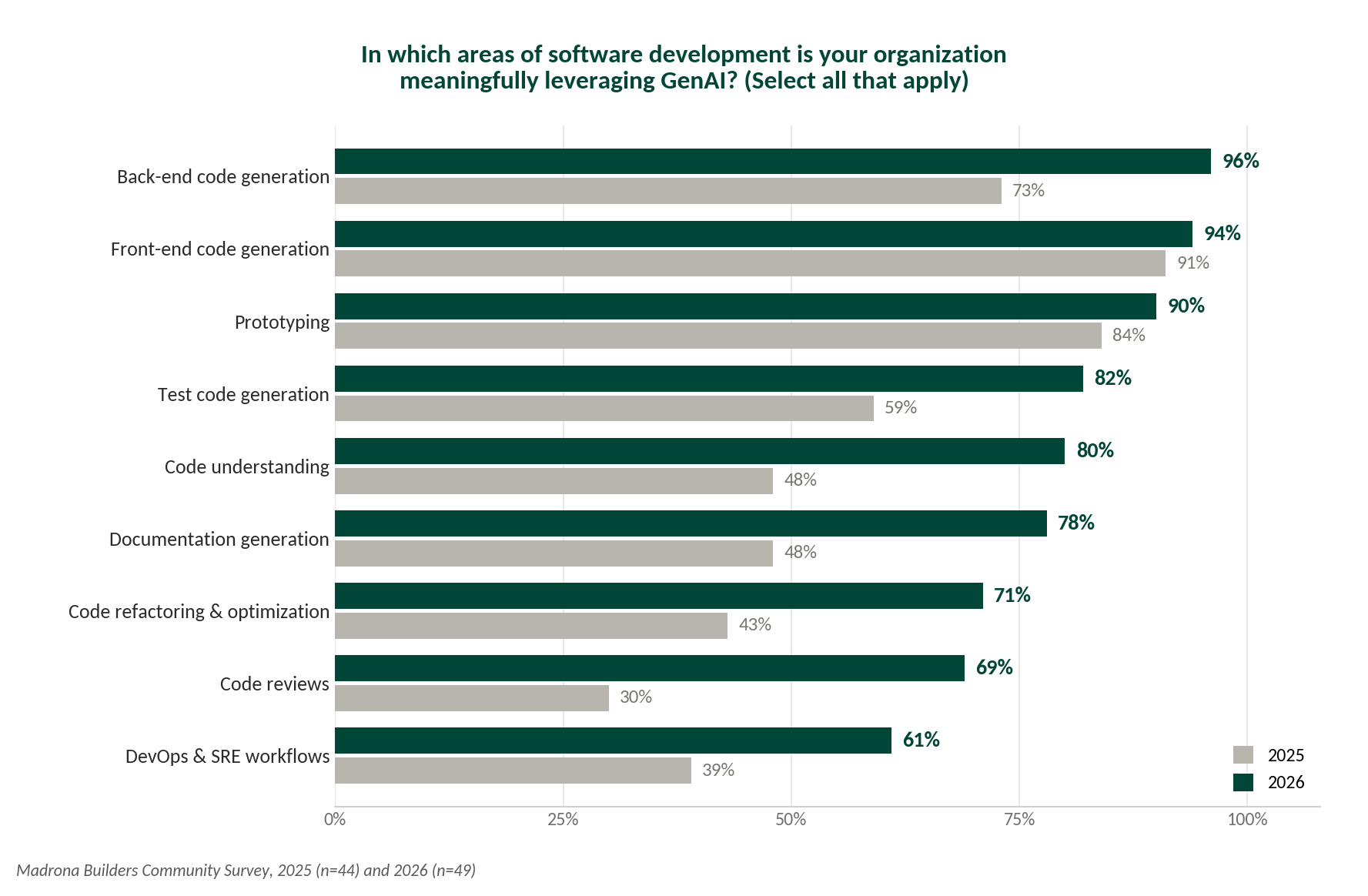
Code generation is now basically universal. The bigger story is what happened across the rest of the SDLC. Code review usage jumped from 30% to 69% — more than doubling. Code understanding went from 48% to 80%. Documentation generation went from 48% to 78%. Refactoring and DevOps workflows saw similar increases.
Soon, use of AI capabilities will be universal across the full lifecycle, meaning next year may be the last time this question is worth asking.
Velocity is improving with mixed views on quality
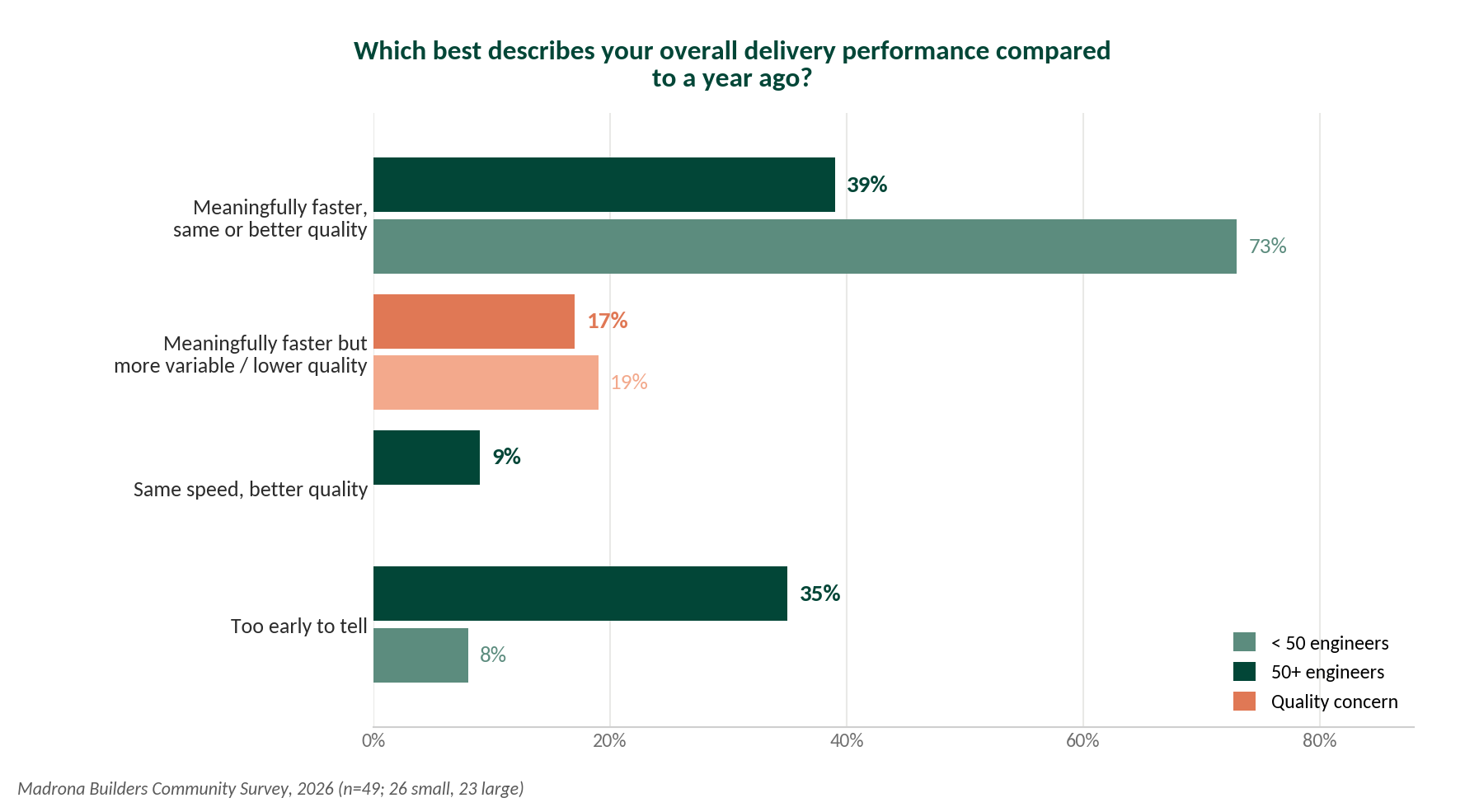
We asked respondents how their delivery performance has changed over the past year. The headline is encouraging: a majority say they’re meaningfully faster, and most of those say quality is the same or better.
There’s an important second signal in the data. 19% of smaller teams and 17% of larger teams report that while they’re shipping faster, quality has gotten more variable or worse, which sets up the validation conversation in the next section.
A note on the small-versus-large split here, since it’s visible in the chart. 73% of smaller teams say they’re meaningfully faster with the same or better quality, compared with 39% of larger teams. 35% of larger teams say it’s still too early to tell, compared with 8% of smaller teams. That difference likely reflects context as much as capability. Smaller teams tend to be newer, more greenfield, and often adopt AI from the start. Larger organizations are navigating legacy systems, established processes, and wider variation in how quickly engineers adopt new tools.
A separate survey question helps explain the difference. We asked which best describes AI proficiency across the organization. Among smaller teams, 58% chose “broadly distributed — most engineers are ramped and seeing meaningful productivity gains.” Among larger teams, the picture flips: only 39% chose broadly distributed, and 52% chose “wide variance — some engineers are getting substantial benefit, others are struggling to get value.” The gains in larger organizations are there, but less uniform.
Measuring productivity remains unsolved
One reason many leaders still say it’s “too early to tell” is that the industry hasn’t settled on how to measure AI’s impact.
63% of respondents rely primarily on anecdotal feedback and team sentiment. 41% are tracking outcome metrics such as features shipped, time to market, or defect rates. Only 16% are using traditional DORA-style metrics. 12% aren’t measuring in a structured way at all. The honest read is that we’re still figuring this out.
Validation is the next big hurdle

Two different questions, same answer: validation is the bottleneck.
When we asked where bottlenecks have shifted, 57% named code review queue time and 49% named spec or requirements clarity — the top two answers by a wide margin. When we asked separately what’s blocking teams from giving AI more autonomy, the top answer for both small and large teams was capacity for validation and human review (around 35% each).
Both quality and velocity are at stake here. Historically, code churn and defects have gone together — more churn, more bugs. If we push more code through the system without improving how we validate it, the quality signal we already see in the data (the 17% to 19% reporting more variable quality) may go in the wrong direction.
Part of getting past this will be about the tools continuing to improve, particularly in testing and code review. As with code generation, it’s not only capability but trust that we’ll have to work through as we push for more autonomy.
The other part is the practices we wrap around the code. We’ve seen this pattern before. Cloud infrastructure and CI/CD dramatically increased development velocity, but to enable that, we changed our processes for testing, deployment, monitoring, and rollback. We’ll need to continue to evolve our processes to make our new velocity safe.
There’s a deeper problem under all of this: the spec itself. Requirements clarity is part of the same story. 49% of respondents named it as a top bottleneck. We asked separately how the PRD itself is changing, and responses split four ways with no clear consensus. We’re still figuring out what the next generation of specs and PRDs looks like. Getting those artifacts right will be an important part of increasing velocity without sacrificing quality.
Hiring has shifted, both in how we interview and in what we evaluate
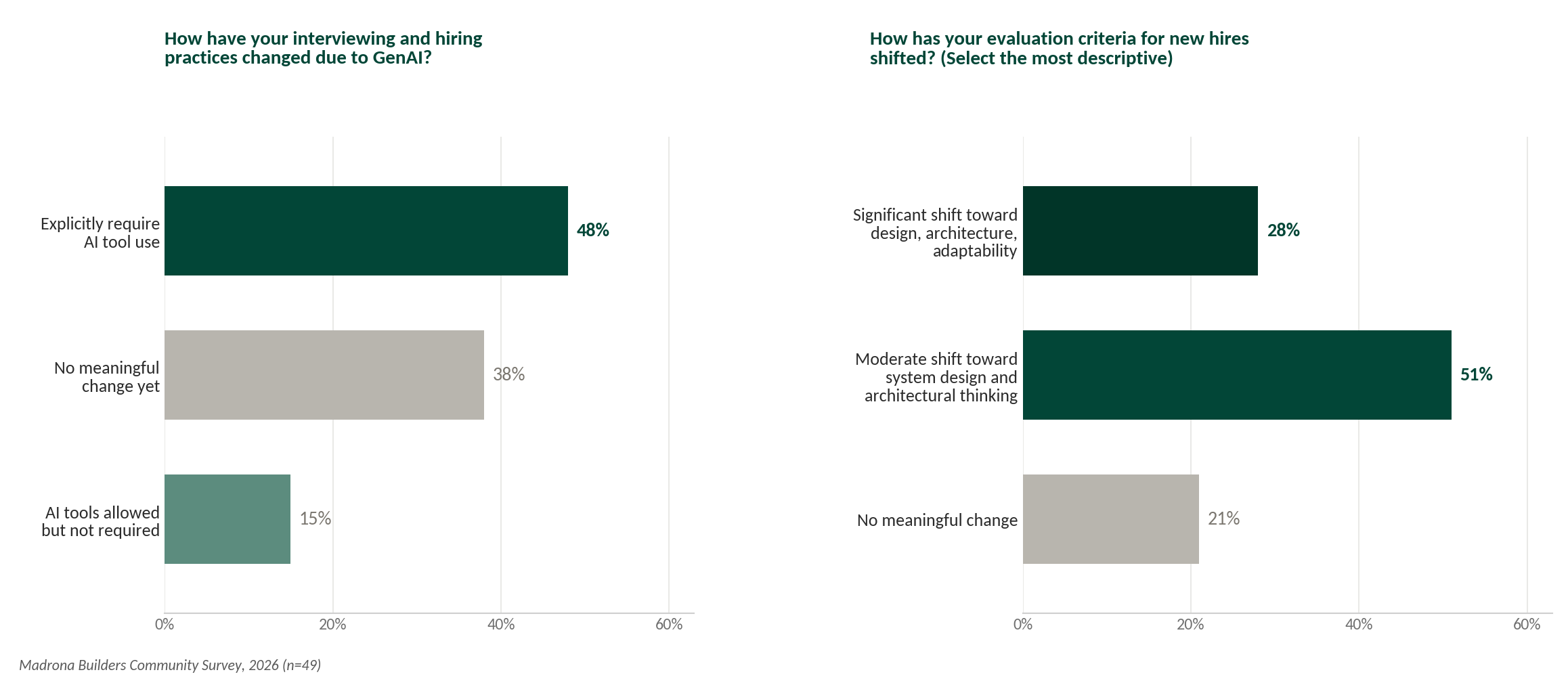
A year ago at our last Builders Summit, we were working through the shift from “let’s ban AI from interviews” to “we’d better test for skill using these tools.” This year, testing for AI development proficiency is increasingly common practice.
The deeper shift is in what we’re evaluating. 79% of leaders report at least a moderate shift in evaluation criteria toward system design, architectural thinking, learning, and adaptability.
The skills that make someone effective with agents are not identical to the skills that make someone effective writing every line by hand. Curiosity, agency, product sense, and the judgment to operate at the right altitude with these tools matter more than they did a year ago.
Looking forward to next year
The next steps in productivity
Getting past validation is one piece. The other is parallelism. As more of the writing and reviewing moves to agents, the developer’s role becomes more like that of a manager and architect working with multiple agents at once across different threads of work. That’s a different kind of productivity, and likely where the next big round of gains comes from.
How organizations evolve
A majority of respondents reported either no structural change yet or only the beginning of one. Across the leading edge of our portfolio, we’re seeing real experimentation with team composition, span of control, and the boundaries between product, design, and engineering. Whether these patterns become widespread will be one of the more interesting stories of the next year.
Across the survey, the pattern is consistent: code creation is accelerating, and review, validation, requirements, and organizational design are becoming the limiting factors. Working through those is the work in front of us.
This survey was the opening framing for the Builders Summit, and the conversations on stage went much deeper into each of these themes. In our next post, we’ll cover what we heard from the speakers: how the people building these platforms see the next phase, how leaders running large engineering organizations are absorbing the change, and where the practitioner consensus is and isn’t. More on that soon.
Thanks to the leaders who took the time to respond, and to everyone who joined us at the Builders Summit.
Related Insights